400. That’s An Error. Your Client Has Issued A Malformed Or Illegal Request. That’s All We Know.
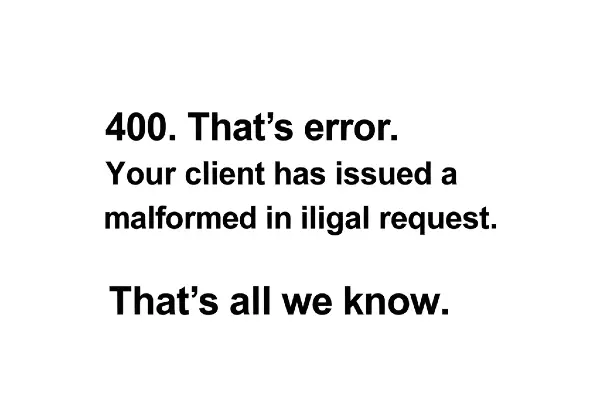
You’ve encountered the message “400. That’s an error. Your client has issued a malformed or illegal request. That’s all we know.” — a concise but frustrating signal that something in the request process went off-track; this article honors your attention to detail and walks you through exactly what the error means, why it happens, and how to diagnose and resolve it quickly and confidently.
What This Error Means
This 400 status is an HTTP response indicating the server cannot or will not process the request because the client sent something malformed, invalid, or unauthorized in the request structure, headers, URL, or payload.
Why It Happens
A 400 arises when the server’s request parser sees unexpected syntax, illegal characters, a too-large header, or semantic violations (for example, invalid encoding or missing required parameters) that prevent safe processing.
Common Client-Side Causes
Browsers, proxies, or client code can send corrupted cookies, malformed URLs (illegal characters or percent-encoding errors), wrong Content-Type headers, or truncated requests due to network interruption, and any of these quickly provoke a 400.
Common Server-Side Causes
Servers and reverse proxies may enforce strict request parsing and reject inputs that exceed size limits for headers or URL, contain invalid characters, or mismatch expected encodings; buggy routing or middleware that misinterprets valid requests can also return 400.
How To Troubleshoot As A User
Clear cookies and cache, try the request in a private window or another browser, verify the URL is correctly typed and properly encoded, and disable browser extensions or proxies that might alter requests — these simple steps resolve most client-edge problems.
How To Troubleshoot As A Developer
Reproduce the request with curl or Postman, inspect request line, headers, and body, compare Content-Type and encoding expectations with the server, and try incremental simplification of the request to isolate the offending field or header.
Logs And Diagnostic Steps
Examine server and proxy logs for the exact request line and parser errors, enable verbose request parsing logs if available, capture traffic with tcpdump or Wireshark to see raw bytes, and correlate timestamps to pinpoint whether truncation or illegal bytes caused rejection.
Immediate Fixes And Workarounds
If urgent, shorten overly long URLs or headers, remove problematic cookies, correct encoding (use percent-encoding for special characters), set appropriate Content-Type and Content-Length headers, or route through a different proxy while you investigate the root cause.
How To Prevent Future 400 Errors
Validate and sanitize outbound request data on the client, enforce consistent encoding (UTF-8), implement retry and exponential backoff for network errors, set conservative header and URL length limits client-side, and add robust input validation and graceful error reporting on the server.
Quick Checklist
Use this checklist to triage fast and efficiently:
- Verify the URL is correct and properly encoded.
- Clear cookies and disable extensions that modify requests.
- Check Content-Type and body encoding for mismatches.
- Reproduce with curl/Postman and simplify the request.
- Inspect server/proxy logs and capture raw traffic if needed.
When To Contact Your Host Or API Provider
If logs show no malformed request on your side or the error persists after validating request structure and encoding, contact your host or API provider with timestamped request examples and raw captures so they can inspect server-side parsing, proxy rules, or firewall filters.
Conclusion
You’ve done the right thing by investigating a 400 error: it’s a clear sign that something in the request layer needs correction, and with targeted checks of URLs, headers, encodings, and logs you can resolve it quickly and prevent recurrence — your attention to these details ensures robust, reliable integrations.